
“The Koshi IT Hub: Building Nepal’s Second Digital Economy”
Bhupin Baral
April 29, 2026
“A vision for decentralizing Nepal’s IT industry into the foothills of the Himalayas”
Building Nepal’s second digital economy in the foothills of the Himalayas.
Kathmandu carries a sector it can no longer house. Koshi has the land, the climate, and the people to receive it. This is the case for moving Nepal’s IT industry east.
Nepal’s IT industry is thriving and suffocating at the same time. Service exports crossed an estimated $1 billion in 2025, more than doubling in three years. Roughly 100,000 people now work in the sector. The government has set a ten-year target of Rs 3 trillion in IT exports and 500,000 jobs.
Almost all of it is happening in one valley.
Kathmandu carries a digital economy that has outgrown the basin it was born in. The valley’s adult population has grown from 0.52 million to 4.1 million. Its air consistently ranks among the worst in the world. Real estate prices have detached from any reasonable salary base. Engineers commute through traffic that costs them two hours of their day before they open a laptop.
This is the picture I want to challenge: that “Nepal’s IT industry” must be synonymous with “Kathmandu’s IT industry.” It does not have to be. And the sooner we admit that, the sooner the next phase of growth begins — in the east.
By the numbers
Metric Value Source $1B+ Estimated IT service exports, 2025 NAS-IT / Kathmandu Post, 2026 ~100K Workers in Nepal’s IT sector Kathmandu Post, 2026 4.1M Adult population, Kathmandu Valley ScienceDirect, 2025 9.2× Kathmandu PM2.5 vs WHO guideline IQAir, 2026
01 / The Vision — A second digital economy, eastward.
The proposal is simple in its premise and ambitious in its scale: declare Koshi Province a designated IT growth corridor, anchored around the towns and tea-country of Tinjure, Kanyam, and the broader eastern hills. Build the policy scaffolding so that companies and engineers have a real reason to move — not as exile from Kathmandu, but as expansion into a better life.
This is not a relocation. It is a rebalancing. Kathmandu remains the historical center. Koshi becomes the second engine.
An engineer should be able to write production code in the morning, walk through a tea garden at lunch, and breathe air that does not require a mask. None of that is fantasy. It is geography we already have.
02 / Tax Incentives — The only lever that actually moves capital.
Companies do not relocate because of poetry about the mountains. They relocate when the math works. Nepal already has precedent here — the FY 2023/2024 budget offered a 50% tax relief for BPO companies exporting their services. The same instrument can be sharpened and pointed eastward.
A workable structure looks something like this:
01 · Corporate tax holiday for relocating IT firms A 7–10 year window for companies that move headquarters or open primary engineering offices in Koshi Province. Tied to verified employment numbers, not just registration.
02 · Personal income tax relief for engineers who migrate Reduced personal tax for IT professionals registered as residents in Koshi for 5+ years. The incentive that actually moves talent is the take-home figure, not the brochure.
03 · Customs and duty exemptions on hardware GPU clusters, networking equipment, server hardware imported into the corridor — zero duty for the first decade. A direct signal to AI-first firms that on-prem and self-hosted infrastructure is a Koshi-friendly choice.
04 · Land allocation at concessional rates Designated tech parks near Tinjure and Kanyam, leased on long terms with construction-ready power and fiber. Real estate is where this proposal either lives or dies.
03 / Why Tinjure and Kanyam — Connecting code with cloud forest.
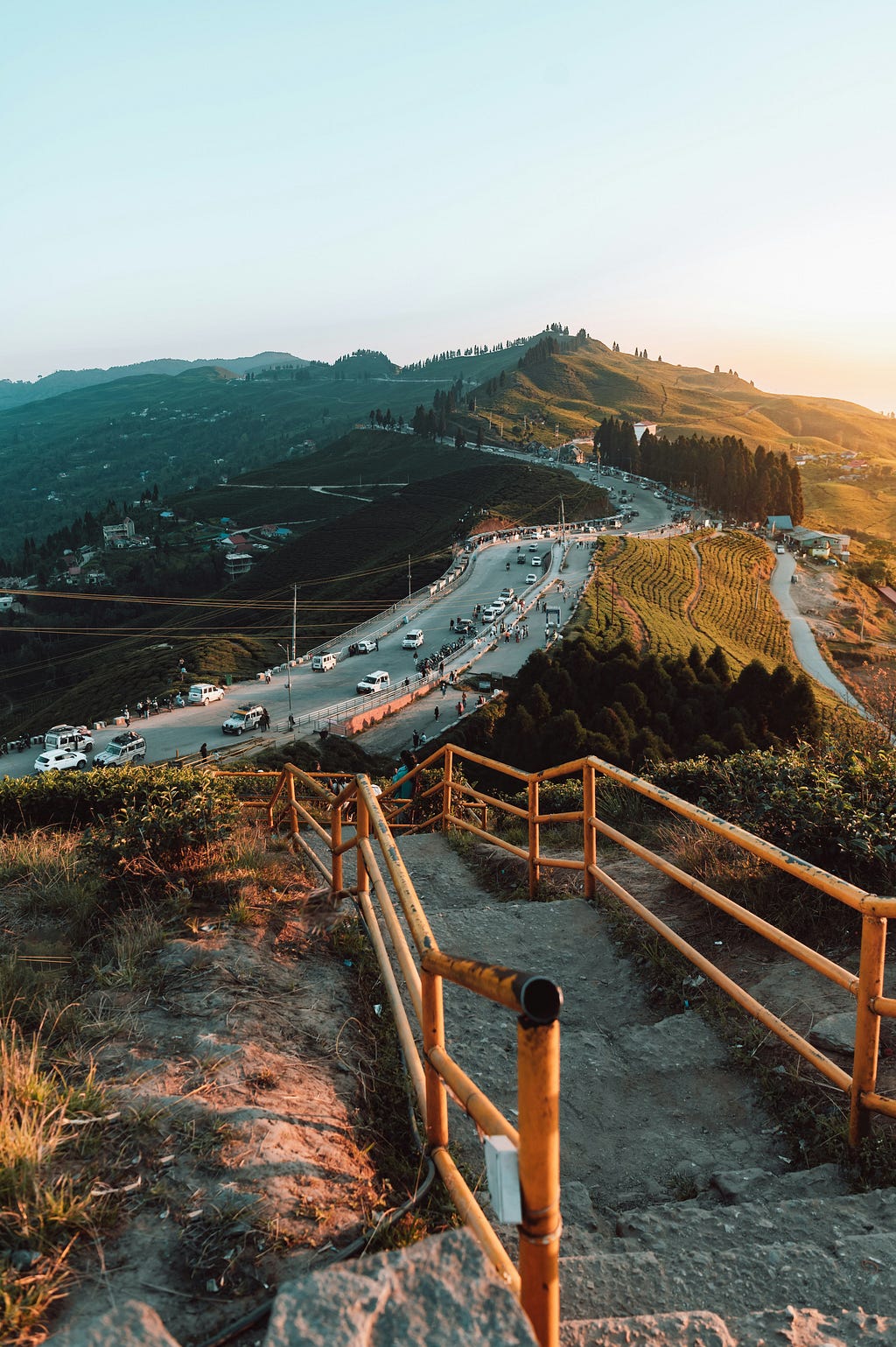
There is a reason these names matter. Tinjure-Milke-Jaljale sits at the heart of one of the most beautiful rhododendron forests on earth. Kanyam is Nepal’s tea country — rolling green that runs into Darjeeling on the horizon. The climate is temperate. The land is not landlocked by a single basin’s pollution. The internet — with the right backbone investment — can be made world-class.
Engineers are knowledge workers. Knowledge workers do not need to be in traffic. They need fiber, power, and a place worth staying in. Nepal’s east has two of three already; the third is a policy decision.
And consider what the migration releases on the other end. Kathmandu’s real-estate market has been distorted by demand it cannot vent. Engineers paying Rs 25,000–40,000 monthly for a one-bedroom share is not a healthy ecosystem; it is a bottleneck masquerading as a market. Pull 20,000 IT workers out of the valley over a decade and the pressure on rent, transport, and schools becomes navigable again. The valley breathes. So do the people in it.
04 / The Second-Order Effects — What no spreadsheet captures.
Tax incentives are the entry-point. The real prize is what happens around them.
Local agriculture finds a market. A software company with 200 engineers needs canteens, cafés, supply chains. Tea farmers in Ilam, vegetable growers in Dhankuta, dairy farmers across Koshi — they suddenly have a high-margin urban customer base inside their own province. Fresh produce stops being shipped to Kathmandu and getting paid Kathmandu prices. It is consumed locally at fair prices.
Real estate equalizes. Koshi’s land values rise from a low base instead of Kathmandu’s land values continuing to inflate from an already-impossible base. The wealth distribution actually broadens.
Demographic pressure reverses. For the first time in a generation, ambitious young Nepalis from the east have a reason to stay east — or to come back. The brain drain that runs Kathmandu → Gulf → Australia loses one of its early-stage funnels.
The cultural posture changes. An IT industry that exists alongside cloud forest, rather than alongside thermal inversion, projects a different image to foreign clients. It is also a different image to ourselves.
05 / Honest Risks — The vision is not free of friction.
I want to be clear-eyed. A vision that pretends the obstacles are minor is just a brochure.
The east will need fiber backbone investment on the order of hundreds of millions of dollars before any serious software company commits. The current grid in many of these areas is not yet ready for sustained server loads. International airports nearby — Bhadrapur and the planned upgrades to regional connectivity — must hold their schedules.
Educational institutions in the corridor need to scale. You cannot build an IT hub without engineers nearby. Universities in Dharan, Biratnagar, and Itahari should be funded toward a CS and ML focus the same way the tax incentives are sharpened.
And policy stability matters more than policy generosity. A 10-year tax holiday that disappears after a change of government is worse than no tax holiday at all. Whatever is offered must be statutory, not budgetary — written into law, not into a finance minister’s annual speech.
06 / The Larger Frame — Nepal’s place in the global AI value chain.
The conversation about Nepal’s IT future is no longer about call centers and basic outsourcing. The global market has moved. AI infrastructure, MLOps engineering, model deployment, and data-secure private AI systems are the high-margin layer — and they are services that can be delivered from anywhere in the world with good fiber and good engineers.
Nepali engineers are already shipping production AI for clients in San Francisco, London, Singapore. The question is whether the infrastructure surrounding those engineers stays trapped in one valley, or expands into something the country can actually live in.
A Koshi IT corridor is not a feel-good economic policy. It is a competitive strategy. Countries that build distributed tech ecosystems — Estonia, Vietnam, parts of Eastern Europe — outperform countries that concentrate them in a single capital and watch that capital choke.
A nation’s economic future is rarely decided by what it builds in its biggest city. It is decided by what it has the imagination to build somewhere else.
Sources
- Kathmandu Post (2026) — Nepal’s IT exports near $1 billion. Can the momentum be sustained?
- Kathmandu Post (2024) — Nepal sets IT export target of Rs 3 trillion over next decade
- IIDS (2022) — Unleashing IT: Advancing Nepal’s Digital Economy
- ScienceDirect (2025) — Impact of wildfire smoke on air pollution-related premature mortality in rapidly growing Kathmandu Valley
- IQAir (2026) — Kathmandu among top 10 most polluted cities in the world